Cart
0
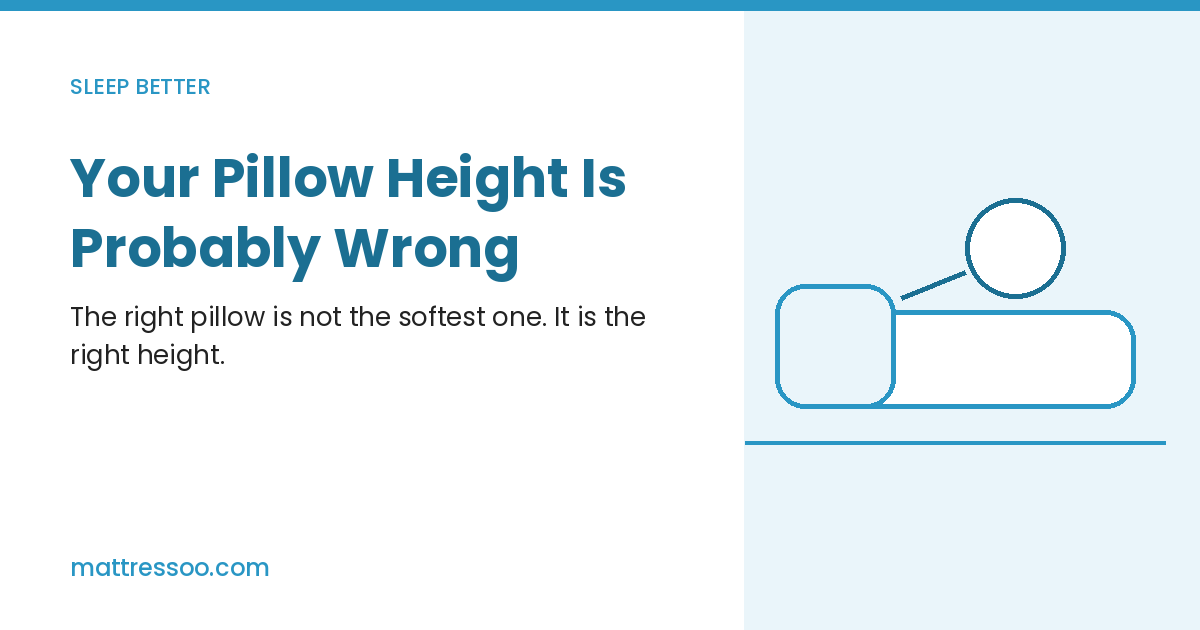
People replace their mattress every few years and their pillow almost never. Which is backwards, because a pillow sits directly under your neck — the part of your spine with the least support of its own.
If you wake up stiff, the pillow is the first thing to check. And the fix is usually not "softer". It is the right height.
The test that takes ten seconds
Lie down the way you normally sleep. Get someone to look at you from the side, or take a photo.
Your nose should line up roughly with the centre of your chest, and your neck should continue the line of your spine. Not tilted up, not dropped down.
- Chin pushed toward your chest — pillow too high
- Head tipped back, chin up — pillow too low
- Head level, neck straight — that is the one
Most people are on a pillow that is too high, because high pillows feel supportive when you first lie down. Then you spend seven hours with your neck bent.
How you sleep decides the height
Side sleepers
You need the most height of anyone. There is a gap between your ear and the mattress roughly as wide as your shoulder, and the pillow has to fill it. Too thin and your head drops toward the mattress, bending your neck sideways all night.
Broader shoulders need more height, not less. A soft, full pillow that you can tuck into works well here — our Cuddle Buddy is built for this, and it also supports the top knee, which takes strain off the lower back.
Back sleepers
You need medium height. Enough to support the natural curve behind your neck, not so much that your chin tucks in.
A contoured pillow helps more than a flat one here, because the raised edge sits under the neck while the dip takes the head. That is what the Moon Curve is shaped for.
Stomach sleepers
You need the least height — and honestly, the position itself is hard on your neck, because your head is turned sideways for hours.
If you cannot change the habit, use the thinnest pillow you can tolerate. Anything thick forces your head back and compresses the base of your neck. A slim low-height pillow is the right call.
People who move around
If you start on your side and wake up on your back, no single fixed height is right all night. An adjustable pillow solves this — the Hybrid Split opens with a zip so you can set the height and firmness yourself, and change it later when you realise you got it wrong the first time.
Three things people get wrong
Two pillows stacked. If one feels too low, people add another. Two pillows almost always overshoot, and the stack shifts during the night. Get one pillow at the right height instead.
Judging it in the shop. Pressing a pillow with your hand tells you nothing about how it holds your head for seven hours. Only sleeping on it does.
Ignoring how old it is. Foam and fibre both compress. A pillow that was the right height three years ago may be an inch flatter now, and you will not have noticed it happening.
When it is not the pillow
If you have changed pillows and the stiffness has not improved after a few weeks, it may be the mattress — a sagging mattress drops your shoulder and no pillow can correct for that. And if the pain is sharp, spreads down your arm, or wakes you at night, see a doctor or physiotherapist rather than buying anything.
Find yours
Our pillow finder asks five questions about how you sleep and points you to one pillow. Or browse all pillows and read the descriptions — each one says who it is actually for.